Find out why knowing the alphabet is so important and learn it quickly.
“Please spell out the email address.”
“M as in Maria, I as in Irene, R as in Roma, C — C as in casa, O… underscore…” — I listen intently, trying to write everything down without making a mistake.
This wasn’t the first time I’d had such a conversation with a client. Spelling out a complicated email address over the phone, in a hurry, with background noise — it’s a stressful situation, especially in a foreign language.
Fortunately, that time it was English — a language I know quite well.
But what if next time I have to do the same thing… in Italian?
✍️Why Is It Worth Knowing the Italian Alphabet?
Before you start speaking Italian, it’s worth getting to know the alphabet well. Why? Because it’s the foundation — not only for learning pronunciation and writing, but also for effective communication.
Imagine someone giving you their name or email address over the phone. Without knowing the alphabet, this situation could easily end in frustration — both for you and for the person on the other end.
✅Why Is Knowing the Alphabet Important?
Pronunciation – you understand the sounds better and master them faster
Spelling – you know how to write Italian words correctly
Reading – you read faster and recognize patterns
Communication – spelling out emails, names, city names, etc.
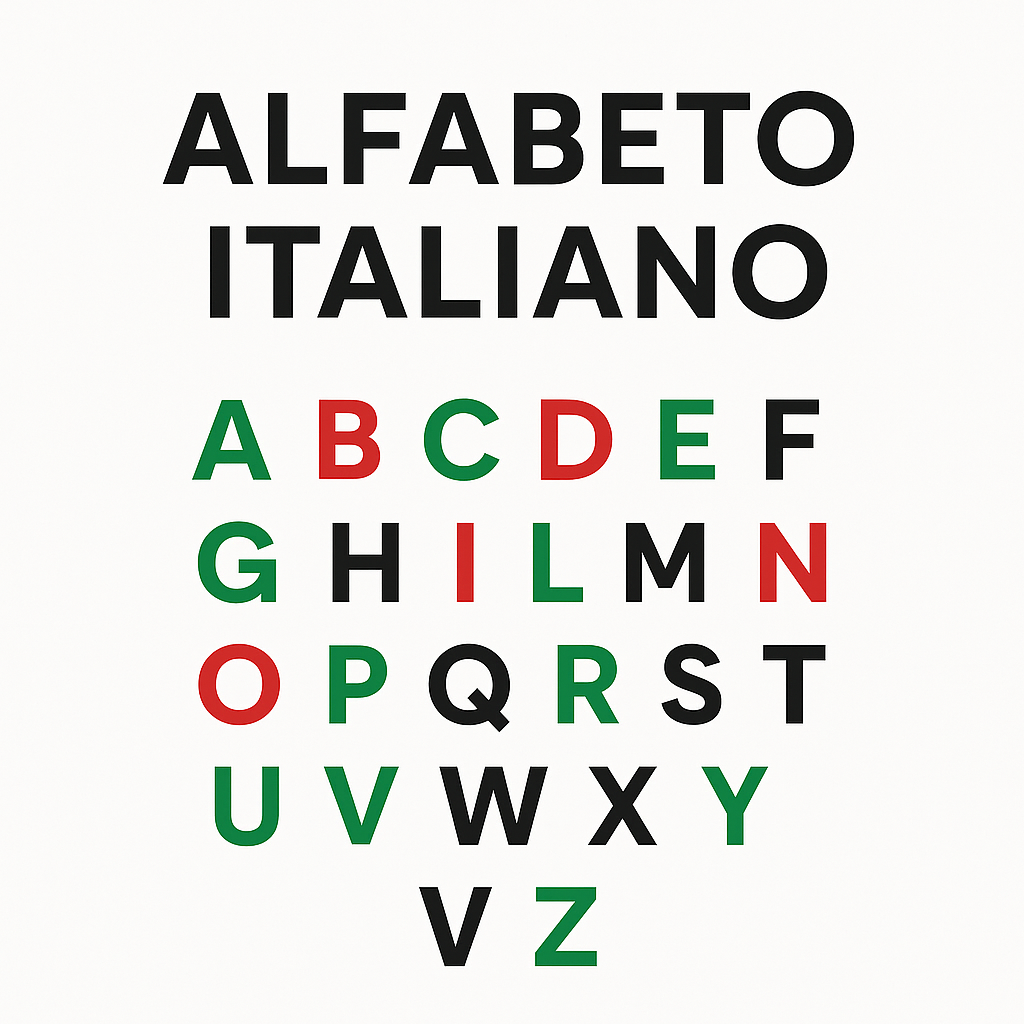
🔤The Italian Alphabet — 21 Letters You Need to Know:
A, B, C, D, E, F, G, H, I, L, M, N, O, P, Q, R, S, T, U, V, Z
📝 Tips:
- The letter H (acca) has no sound on its own, but it affects the pronunciation of words (e.g. chiamare, che).
- The letter Q (cu) always appears as qu and sounds like “kw” — e.g. quattro.
- Z can be pronounced as “dz” or “ts”, depending on the word (e.g. zaino vs. pizza).
- R (erre) in Italian is clearly rolled — it’s worth practicing.
🇮🇹 The Italian Alphabet — Pronunciation and Sound of the Letters
| Letter | Pronunciation in Italian | Sound (phonetic guide in English) |
|---|---|---|
| A | a | "ah" (as in "father") |
| B | bi | "b" (as in "boy") |
| C | ci | "ch" (before e, i — as in "cheese") / "k" (before a, o, u — as in "cat") |
| D | di | "d" (as in "dog") |
| E | e | "eh" (as in "bet") or "ay" (as in "they") |
| F | effe | "f" (as in "fish") |
| G | gi | "j" (before e, i — as in "jeep") / "g" (before a, o, u — as in "go") |
| H | acca | silent letter — no sound |
| I | i | "ee" (as in "machine") |
| L | elle | "l" (as in "love") |
| M | emme | "m" (as in "mother") |
| N | enne | "n" (as in "nice") |
| O | o | "oh" (as in "go") |
| P | pi | "p" (as in "pen") |
| Q | cu | "kw" — always used as "qu" (as in "quick") |
| R | erre | rolled "r" — trilled sound |
| S | esse | "s" (as in "sun") or "z" (as in "rose") — depends on word |
| T | ti | "t" (as in "top") |
| U | u | "oo" (as in "boot") |
| V | vi | "v" (as in "violin") |
| Z | zeta | "dz" (as in "adze") or "ts" (as in "pizza") — depends on word |
❌ Letters Not Included in the Italian Alphabet:
J, K, W, X, Y
These last letters (J, K, W, X, Y) appear in loanwords, brand names, and similar cases. That’s why it’s useful to know their names and how they are pronounced in Italian.
| Letter | Pronunciation in Italian | Letter Name | Notes |
|---|---|---|---|
| J | like "i lunga" | i lunga | "Long i" — e.g. jeans, Juventus |
| K | like "kappa" | kappa | e.g. ketchup, kiwi, karate |
| W | like "doppia vu" | doppia vu | "Double v" — e.g. weekend, watt |
| X | like "ics" | ics | e.g. taxi, xilofono (xylophone) |
| Y | like "ipsilon" | ipsilon | e.g. yogurt, nylon |
🗣️ Pronunciation and Spelling
Italian does not have ‘standard’ phonetic rules for these letters, so their pronunciation often follows that of the original language from which the word comes. In everyday communication, spelling out such words may require additional clarification — which is why it’s useful to know their Italian names and common examples of usage.
🔤 BONUS
🛠️ Special characters – how to pronounce them?
Spelling an email address or a website? See how Italians name special characters.
| Character | Italian Name | English Meaning |
|---|---|---|
| @ | chiocciola | at sign |
| . | punto | dot / period |
| - | trattino / trattino semplice | hyphen / dash |
| _ | trattino basso / underscore | underscore |
| / | barra | slash |
| \ | barra rovesciata | backslash |
| # | cancelletto | hash / hashtag |
| & | e commerciale | ampersand (and symbol) |
| * | asterisco | asterisk |
| " | virgolette | quotation marks |
| ' | apostrofo | apostrophe |
| : | due punti | colon |
| ; | punto e virgola | semicolon |
| , | virgola | comma |
| () | parentesi tonde | round brackets / parentheses |
| [] | parentesi quadre | square brackets |
| {} | parentesi graffe | curly brackets / braces |
| = | uguale | equals sign |
| + | più | plus sign |
| % | percento | percent sign |
| ! | punto esclamativo | exclamation mark |
| ? | punto interrogativo | question mark |
🔤 “How to learn the Italian alphabet? Here are 11 ways:
📌 1. Spell your name and surname
Write them down and then say them aloud, spelling each letter in Italian. For an extra challenge, add your street name or city.
📌 2. Repeat the alphabet with an audio
Find a recording (e.g., on YouTube) and repeat the letters aloud every day.
📌 3. Alphabet game
Play alone or with someone – say the next letter in Italian. You can add a category, like animals:
A come ape, B come balena, and so on.
📌 4. Alphabet from memory
Write the alphabet from memory. Check what you missed or got wrong. Try starting from a random letter and continue from there.
📌 5. Brand names in Italian
Write brand names like Nike, Pepsi, Netflix, Zara and spell them in Italian. Pay attention to foreign letters not native to the Italian alphabet (J, K, W, X, Y).
📌 6. Spelling dictation
Ask a friend or teacher to dictate words – letter by letter. Write them down and check your spelling.
📌 7. Letter flashcards
Make or print flashcards with individual letters. Draw one and say an Italian word that starts with it.
📌 8. Thematic alphabet (e.g., food)
For each letter, find one Italian word from a specific category:
A – acqua, B – banana, C – caffè, etc.
📌 9. Rhymes and sentences
Create short sentences where each one begins with the next letter of the alphabet:
Amo la pizza.
Bevo caffè ogni mattina.
Ciao, mi chiamo Luca.
📌 10. Quizzes and apps
Use apps like Duolingo, Memrise, or Quizlet – they offer exercises focused on the Italian alphabet and pronunciation.
📌 11. Practice with email addresses
Try spelling these email addresses in Italian – paying attention to special characters:
Knowing the Italian alphabet is more than just theory – it’s a practical tool that makes life easier.
From correct pronunciation to effortlessly spelling your email over the phone – the alphabet is the first step toward confident communication.
✨ Learn it actively – repeat, write, play, have fun with letters. It doesn’t have to be boring.
If you want more practical language tips – check out my other posts.
👉 Got a question? Have you tried spelling something in Italian? Let me know in the comments!